

Publication Date: March 5, 2026
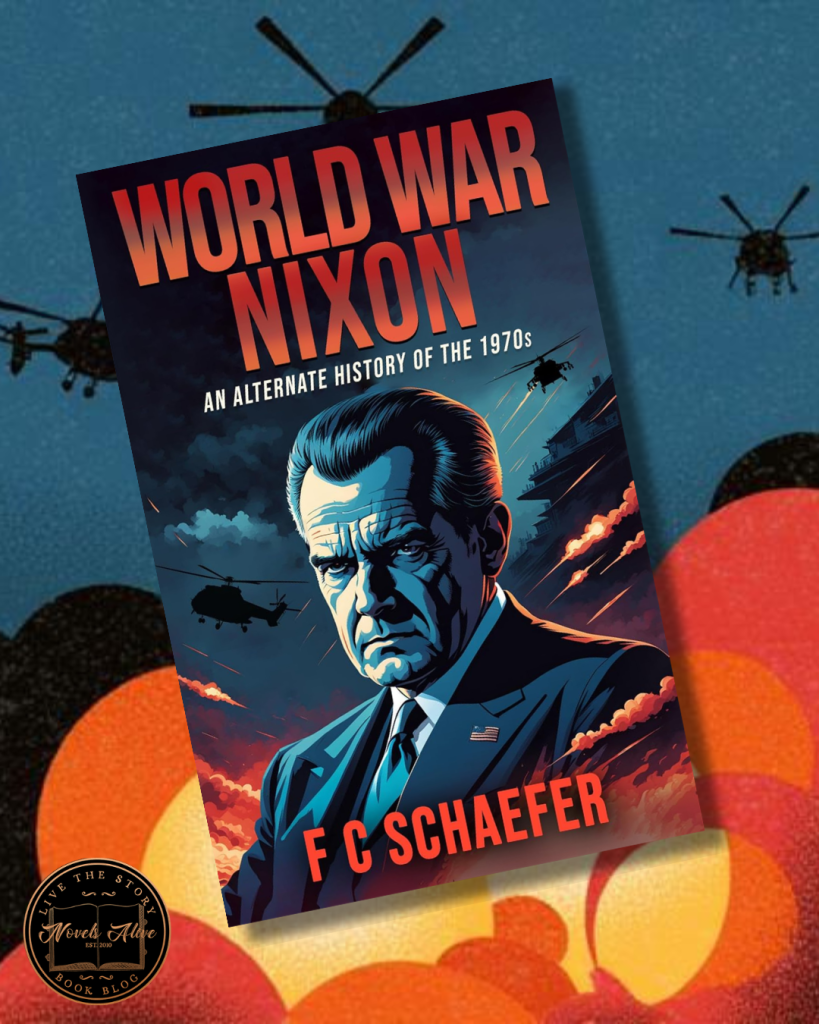
What if he had gotten away with Watergate? No arrest of the burglars trying to bug the offices of the Democratic National Committee; no investigations, no special prosecutors, no impeachment, and most of all, no resignation. What if President Richard Nixon and the men in his administration had a free hand to commit whatever crimes they deemed necessary to further their interests? No enemy would have been safe, no ally above suspicion, and no law strong enough to stand in Nixon’s way of getting what he wanted.
WORLD WAR NIXON is the story of Nixon unbound as he weaves one conspiracy after another in command of an ever-expanding criminal enterprise that spreads from the Oval Office to every corner of America. Meanwhile the closets of the White House fill with ever more skeletons—until they can hold no more, and burst open for all the world to see. It is also the story of how Richard Nixon, refusing to accept defeat in Vietnam, plans to end the Cold War on his own terms—meeting with old enemies behind closed doors and making new alliances, and if the world is forced the brink of a third world war, so be it.
WORLD WAR NIXON takes the reader from secret meetings in the halls of power in Washington D.C. to gatherings behind the closed doors of the Kremlin; from the blood stained jungles of Southeast Asia to the blazing deserts of the Middle East. From a rancher’s opulent home outside Dallas, Texas, to a political bagman’s small office in Montgomery, Alabama; from a cozy suite in the Watergate Complex, to a “safe house” in Florida— places where the fates of so many are decided.
WORLD WAR NIXON is told not only through the eyes of the President himself, but also of his loyal chief of staff; a ruthless mercenary willing to commit any crime for the right price; a loyal secretary blind to what is going on around her; a colonel in the KGB who cannot believe what he is witnessing; an officer in the South Vietnamese army determined to save his country from a dire fate; a young Mexican-American activist bitterly opposed to the Vietnam War; and a high school graduate who joins the army because he needs a job—then ends up in the middle of a war he didn’t see coming. And not only them, but appearances by Leonid Brezhnev, Chairman Mao, Henry Kissinger, John Dean, Bob Woodward, Spiro Agnew, and Steve McQueen, among many others.

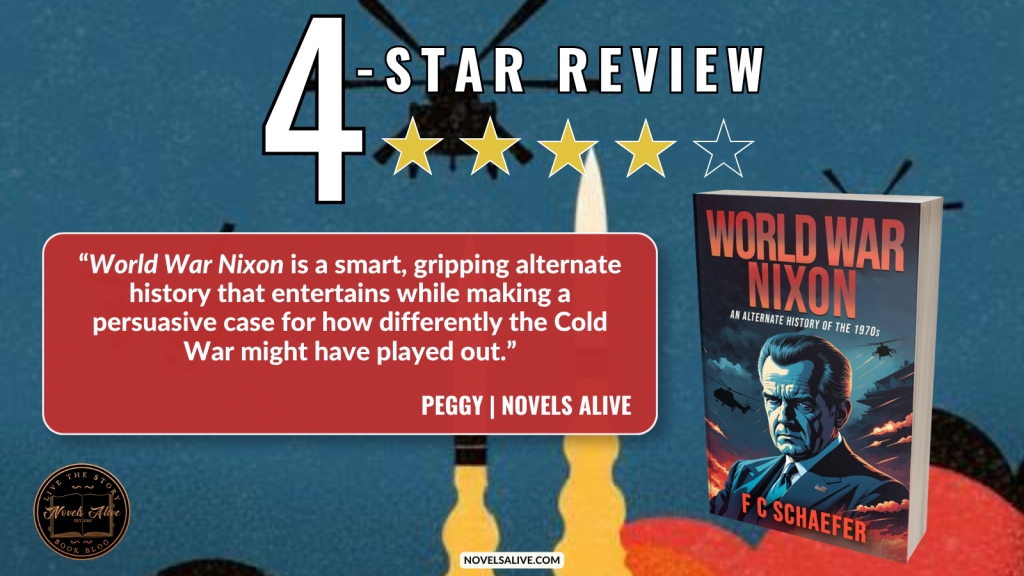
A thrilling alternate history of the 1970s imagines what would have happened if President Richard Nixon never took the fall for Watergate in World War Nixon by F.C. Schaefer.
The novel is a creative adventure into “what if?” land as it explores a series of scenarios and actions that depart from history: what if Nixon was never implicated in the Watergate break-in scandal? What if his historic China visit never occurred? In Schaefer’s clear and concise prose, he paints a radically different outcome in which Nixon’s ambition to end the Vietnam War “with honor” and secure his legacy brings the world to the brink of a third world war.
The story is structured as a series of overlapping and alternating first-person accounts of events from 1971-1976 and moves from Washington, Moscow, Southeast Asia, and the Middle East. All the major historical figures are here, as well: Henry Kissinger, H.R. “Bob” Haldeman, Leonid Brezhnev, Mao Zedong, John Dean, Bob Woodward, and Spiro Agnew, to name just a few. Schaefer expands his vision beyond the White House and the Washington press corps by including diverse perspectives from a covert-ops mercenary, a KGB colonel, a South Vietnamese officer, an anti-war activist, and a young American G.I. serving in Vietnam. The power of these distinct insights reveals the consequences of Nixon’s decisions from both the highest levels of government and those of ordinary citizens and civilians.
Some of the major “breaks” with history include Mao Zedong’s suspicious early death, leading to China’s takeover by a rabidly anti-American communist, Lin Bao. Bao closes China to the “opening” so long planned for by the Nixon administration. At the same time, peace negotiations between America and the North Vietnamese seem to go nowhere, and the 1972 presidential election pits Nixon against Southern demagogue and white supremacist George Wallace (a nightmare election if ever there was one). Nixon inserts his reflections frequently and always with a formidable and braggadocious refrain:
“I am proud of the enemies I made during my years in public life, and though they tried mightily to defeat and destroy me, they did not succeed, not even when they put me on trial for murder.”
Have your attention yet? Schaefer’s choice to write this alternate timeline as an oral history is clever and allows for a range of political opinions and nuanced insights; how he puts himself into the heads of dozens of historical figures is a feat. But it is his encyclopedic knowledge of this era, its key players, and the geopolitical drama brought about by Nixon’s bloodlust against his enemies—both foreign and domestic, and even within his own Republican Party—that makes this story compelling because it is all too plausible.
If the prospect of a military alliance between the United States and the Soviet Union against China seems almost unimaginable, Schaefer’s meticulous plotting and keen grasp of Cold War geopolitics make the scenario feel not only plausible but unnervingly so in the final days of the Vietnam War. Like a military strategist running a series of war games, he repeatedly rolls history’s dice, selecting the most compelling divergences to build an alternate timeline that is as intellectually engaging as it is dramatically satisfying.
History enthusiasts should not be deterred by the novel’s “alternate history” label. Instead, they should embrace the irresistible question that shadows every pivotal moment of the past: What if? Schaefer reimagines Nixon and the turbulent 1970s with both imagination and historical discipline, crafting a story that not only entertains but also invites readers to reflect on enduring questions of political power, leadership, and the unintended consequences of history.
World War Nixon is a smart, gripping alternate history that entertains while making a persuasive case for how differently the Cold War might have played out.



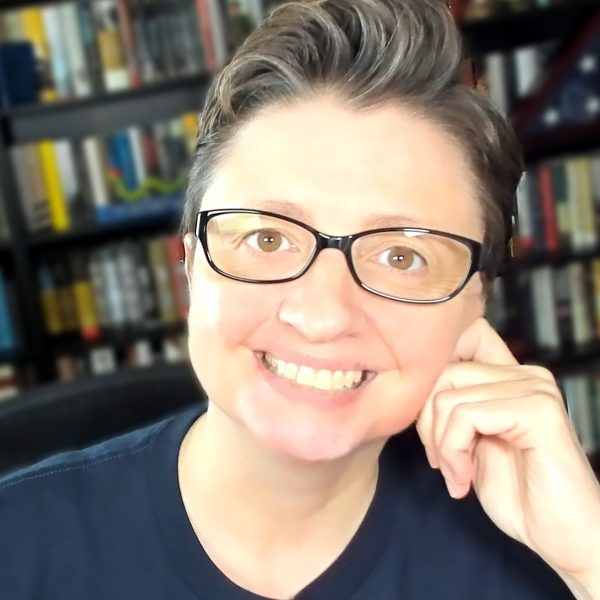
 I am a lifelong avid reader with a passionate love for a good story, be it fiction on nonfiction. As a kid, I loved genre movies-westerns, gangsters, horror-because the story was king with those kind of flicks, same with comic books, another life long passion. After years of reading, I decided to try my hand at writing the kind of fiction I enjoyed and learned there is no greater satisfaction than to labor on something you love and then discover others find pleasure in it as well.