


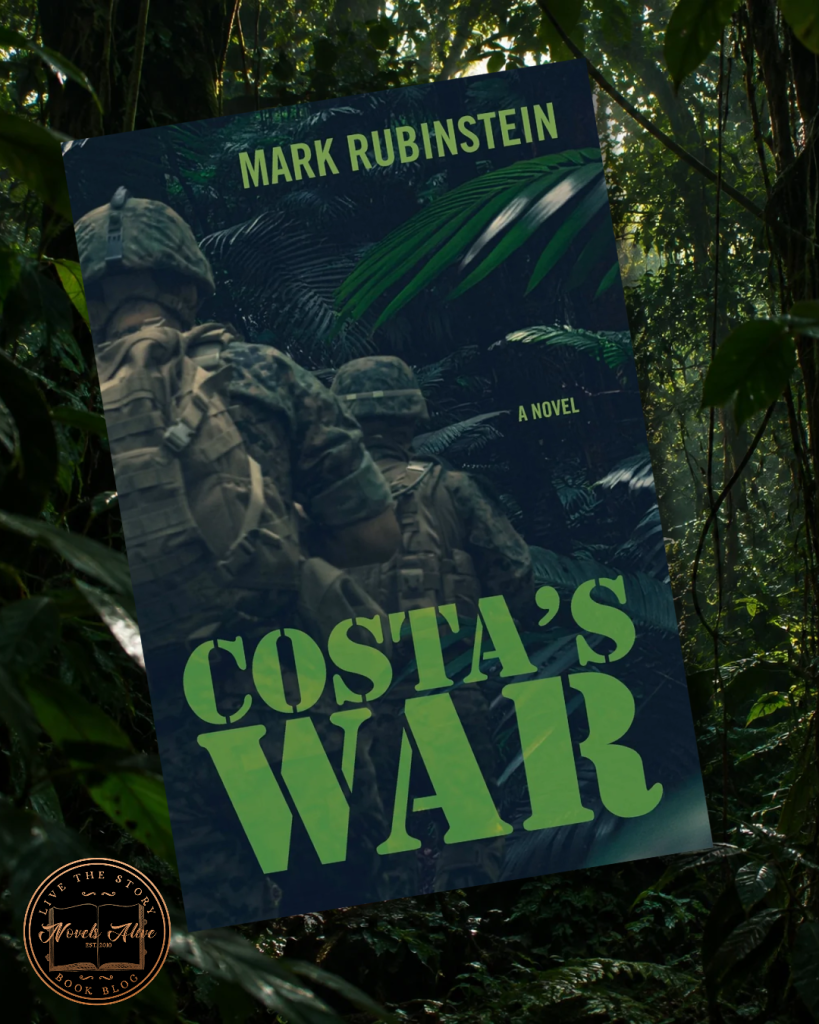

Publication Date: November 10, 2026
Right after college graduation, Costa, a lower-middle-class kid from Buffalo, New York, is drafted into the US Army and plunged into the Vietnam War. Costa’s War catapults the reader back to the conflict that changed America.
This is a compelling novel of morality—right or wrong in a split second in the hell of the jungle—when it really matters, regardless of rank, military orders, or rule books. It asks how a soldier survives, how he deals with dislocation, and how he reacts when given an order that defies everything he’s ever believed about the human soul.

A young man drafted into the Army fights not only the enemy in Vietnam but also against the slippery slide toward inhumanity in Mark Rubinstein’s sobering war novel, Costa’s War.
In 1968, twenty-one-year-old Costa steps off the plane in Da Nang, one of the newest batches of Army “cherries” to arrive for a year-long tour in the jungles of Vietnam. He arrives knowing he is a replacement for a dead man, as are all reinforcements arriving fresh from “the world.” When 2nd Lt. Johnson, a Southern man with a “porcine” face, singles out Costa for his college education, Costa knows his time in Bravo Company will be rough. But with the help of an experienced soldier, Rinaldi, and the battle-hardened noncommissioned officer, Sergeant Davis, Costa feels like he may have a chance to survive Johnson’s maniacal wrath.
This spare, haunting novel of a young man’s life-altering experience and encounters in Vietnam is a thoughtful rumination on war and man’s inhumanity to man. Rubinstein chronicles Costa’s learning curve in Vietnam as he sets out on his first nerve-wracking patrol and witnesses some of Johnson’s cruelty in action. While looking for Viet Cong in the jungle, the Army company will explore hidden tunnel systems, stumble into adrenaline-laced ambushes, and destroy tiny villages or “villes” in the dense bush looking for VC contraband. Beneath it all, Johnson’s unhinged directive to humiliate and terrorize the Vietnamese signals to Costa that the lieutenant has lost a piece of himself to the madness. And he wonders if the same will happen to him.
Rubinstein’s clear, staccato prose draws the reader into Costa’s claustrophobic viewpoint, where the only palpable presence is the jungle—a major character, one that is alive with heat, reptiles, insects, and the hidden VC and NVA (North Vietnamese Army). Costa is a realist from the start, evident in observations that “Army bodies moved through the war like parts on a conveyor belt, uniformed and disposable…” In quiet moments, he thinks of home, his parents, and the girl who may or may not be there when—and if—he returns from his tour of duty.
Explosive moments of battle are rendered in graphic yet authentic detail and keep the reader engaged in Costa’s war, especially via its disturbing visuals of violence and human carnage. However, Costa’s constant musing on his humanity and whether he will lose it and become like Johnson is a bit overplayed. Johnson himself is one-dimensional; a caricature of a wild-eyed killer who will go to any length to be obeyed, whether by innocent villagers or his own soldiers. Davis is the antithesis of Johnson and becomes Costa’s moral guide and unspoken mentor, a soldier who reflects the best qualities of a leader.
The climax of the novel is a foreseeable encounter where Costa must weigh his loyalty to his commanding officer against his own conscience. This scene also suffers from a prevailing problem throughout the novel: Costa’s thoughts and observations of people, climate conditions, smells, and his own worries about becoming a monster become a continual, repetitive refrain. When battles erupt, one welcomes the release that the action sequence provides as a break from the cerebral stream of thought. Still, it is a heartfelt paean to the American infantrymen who went where their country sent them…and came home different.
Costa’s War is a slow burn coming-of-age story of one man’s fight to stay true to himself in the fever vortex of the Vietnam War.




 Mark Rubinstein was born in Brooklyn, New York. He dreamed of playing baseball for the Brooklyn Dodgers since his all-time hero was the Dodgers’ first baseman Gil Hodges. Rubinstein played high school baseball and ran track. His love of sports led him to read sports fiction, and soon he became a voracious reader, developing an enduring love for all kinds of novels.
He graduated from New York University with a degree in business administration. He then served in the army and ended up as a field medic tending to paratroopers of the 82nd Airborne Division. He was so taken with these experiences that after his discharge, he re-entered NYU as a premed student.
He entered medical school at the State University of New York’s Downstate Medical Center. As a medical student, he developed an interest in psychiatry, discovering in that specialty the same thing he realized in reading fiction: every patient has a compelling story to tell. He became a board-certified psychiatrist practicing in New York City.
In addition to running his private practice he developed an interest in forensic psychiatry because the drama and conflict of the cases and courtrooms tapped into his personality style. He also taught psychiatric residents, interns, psychologists, and social workers at New York Presbyterian Hospital and became a clinical assistant professor at Cornell University’s medical school.
Before turning to fiction, Rubinstein coauthored five medical self-help books: The First Encounter: The Beginnings in Psychotherapy (Jason Aronson); The Complete Book of Cosmetic Facial Surgery (Simon and Schuster); New Choices: the Latest Options in Treating Breast Cancer (Dodd Mead); Heartplan: A Complete Program for Total Fitness of Heart & Mind (McGraw-Hill), and The Growing Years: A Guide to Your Child’s Emotional Development from Birth to Adolescence (Atheneum).
Rubinstein lives in Connecticut with his wife and as many dogs as she will allow in the house. He still practices psychiatry and is busily writing more novels. Mad Dog House, his first novel, was named a Finalist for the 2012 ForeWord Reviews Book of the Year Award (Thriller & Suspense) and The Foot Soldier won the Silver award for Fiction at the 2014 Benjamin Franklin Awards.